Bibliography for paper (topic- should the U.S. intervene in Syria?):
http://apps.washingtonpost.com/g/page/world/timeline-unrest-in-syria/207/
https://medium.com/platypus-journal/9fdf2d291339
http://www.bbc.co.uk/news/world-middle-east-24403003
http://live.aljazeera.com/Event/Syria_Live_Blog
http://www.thedailybeast.com/articles/2014/02/03/senators-kerry-admits-obama-s-syria-policy-is-failing.html
http://www.washingtonpost.com/opinions/us-inaction-in-syria-could-be-far-more-costly-than-intervention/2013/12/17/9417c604-6738-11e3-ae56-22de072140a2_story.html
http://www.nytimes.com/interactive/2013/09/10/world/middleeast/american-views-on-intervention-in-syria.html
http://www.economist.com/topics/syria
http://www.economist.com/news/leaders/21595004-conference-syria-not-enough-west-should-also-arm-rebels-desperate-times?zid=308&ah=e21d923f9b263c5548d5615da3d30f4d
http://www.economist.com/news/middle-east-and-africa/21594993-president-bashar-assads-hopes-are-rising-he-may-be-able-use-conference?zid=308&ah=e21d923f9b263c5548d5615da3d30f4d
Tuesday, February 4, 2014

Monday, February 3, 2014
Sunday, November 24, 2013
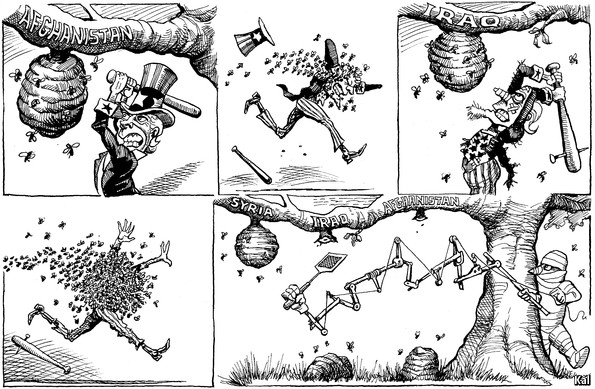
What are we doing here?
US Policy in Syria or Lack Thereof
When
researching this post, I had some trouble finding a clear explanation of what
America is doing in Syria. The simplest and perhaps morally clearest answer is
that we are in Syria to save lives. Thus far, however, we have signally failed
to do so. Bashar Assad launches artillery and air strikes on cities and towns
without even a pretense of aiming at military targets. Jihadist rebels behead
civilians and innocents with impunity, including one of their own on at least
one occasion (http://www.nytimes.com/2013/11/16/world/middleeast/beheading-in-syria-is-called-a-mistake.html?_r=0).
America does nothing. Only when chemical weapons are used to
murder hundreds of civilians does America threaten to intervene. Aha- perhaps
America’s goal is to prevent the proliferation and use of these hideous
weapons? But in that case, why have we failed to prevent the numerous small-scale
chemical weapons uses over the course of the war? Even more telling, why are we
training and arming groups of rebels in Jordan whose only stated goal is to
topple Assad and have no interest in containing chemical weapons? However, if
we are actually attempting to topple Assad, as our support of these groups
would suggest, why haven’t we intervened more directly? The aforementioned
chemical attacks and humanitarian abuses provide a ready excuse to establish a
no-fly zone, at the very least; that is, if the American people were willing to
make that commitment.
And
that, I believe, is the source of the contradictory objectives in Syria. The
people would like to see the humanitarian abuses but are unwilling to expend
American lives on doing so. They want Assad gone but are unwilling to become
embroiled in another Iraq or Afghanistan. But the current conflicting
approaches provide the worst of both worlds. By lending our name to the Syrian
opposition we allow our enemies to paint every Assad victory and indeed the
very survival of the regime as a victory against the overwhelming might of the
United States. The longer we stand with our toes in the water, the more brutal
Assad will be and the less palatable the opposition will become. Yet the humanitarian
crisis will only deepen, making it harder to back out entirely.
And the American people
will complain innocently about our loss of prestige and respect abroad.
Either get in or get out.
Monday, November 18, 2013
Where’s the Money?
Sources of funding and influence in the Syrian Conflict
1.
The Assad Regime
A) Iran/Hezbollah: Iran and its
regional ally, Hezbollah, have always been staunch backers of the Assad regime.
However, they have recently become active participants in the war as well. In June
a battle that was internationally seen as signifying a change in momentum from
the rebels to the regime was fought over the strategic town of Qusayr. However,
the battle was planned and fought in large part by Hezbollah, under orders from
Iran.
B) Russia: Syria is Russia’s
only remaining ally in the middle east, as well providing its last naval base
there. Accordingly, Russia has provided everything short of overt military involvement,
including weapons sales and U.N. assistance. Interestingly, however, Russia
cooperated with the U.S. on destroying Assad’s chemical weapons.
2.
The Rebels
A) Saudi Arabia/Qatar: Saudi
Arabia and Qatar are Iran’s regional rivals. While Iran arms and supports the
Shiite Assad regime Saudi Arabia and Qatar fund several Sunni Islamist rebel
groups, although they have not yet directly involved themselves militarily. Funds
come from both governments and private individuals, with governments outwardly supporting
more moderate groups and individual funds flowing to more radical Jihadists,
including Al-Qaeda affiliates.
B) Al Qaeda: Al-Qaeda supports
several Sunni militias in Syria, most notably Jahbat Al-Nusra (The Nusra Front).
Additionally, the Al-Qaeda affiliate ISIL (The Islamic State in Iraq and the
Levant) is actively fighting in Syria and in fact attempted to merge with the
Nusra front before the merger was rejected by the leaders of the Nusra front
and mainstream Al-Qaeda.
C) The U.S.: Although America
does not have a direct stake in the civil war (outside of ensuring thsat
chemical weapons do not fall into the wrong hands), it opposes the Assad regime
for humanitarian reasonsAmerica has not intervened directly in the conflict,
especially as the opposition has gone from largely secular to increasingly
Islamicized. However, it has provided assistance, arms and training to the
rebels, with funds being funneled through the Syrian National Council (a
secular government-in-exile) and the Free Syrian Army (the largest moderate/secular
group rebel militia).
Thursday, October 17, 2013
Hi! I'm going to be blogging about the evolving situation in Syria.
To start out, this is a brief timeline of the events thus far (adapted from theweek.com and nytimes.com):
To start out, this is a brief timeline of the events thus far (adapted from theweek.com and nytimes.com):
February 22, 2011
Inspired by the Arab Spring uprising elsewhere, 15 teenagers write anti-regime graffiti on various walls and are arrested.
Inspired by the Arab Spring uprising elsewhere, 15 teenagers write anti-regime graffiti on various walls and are arrested.
March 25, 2011
Syrian troops fire into a reportedly peaceful demonstration over the teens' arrests, killing several.
Syrian troops fire into a reportedly peaceful demonstration over the teens' arrests, killing several.
May 18, 2011The United States imposes sanctions on Syria in response to a month of violent crackdowns by the regime, which had killed at least 700 people to that point.
August 18, 2011
The leaders of Britain, France, and Germany join the United States in calling for Assad to resign.
The leaders of Britain, France, and Germany join the United States in calling for Assad to resign.
November 12, 2011
The Arab League, which includes Egypt, Saudi Arabia, and 20 other countries, votes to suspend Syria's membership and threatens to impose economic and political sanctions if it doesn't stop the crackdown against protesters.
The Arab League, which includes Egypt, Saudi Arabia, and 20 other countries, votes to suspend Syria's membership and threatens to impose economic and political sanctions if it doesn't stop the crackdown against protesters.
February 4, 2012
300 people are killed in Homs by a barrage of artillery fire from Syrian government forces, prompting international condemnation. Shortly thereafter, China and Russia veto a resolution by the U.N. Security Council backing an Arab League peace plan for Syria.
300 people are killed in Homs by a barrage of artillery fire from Syrian government forces, prompting international condemnation. Shortly thereafter, China and Russia veto a resolution by the U.N. Security Council backing an Arab League peace plan for Syria.
August 21, 2012
President Barack Obama lays down a red line on the use of chemical weapons Opposition activists put the death toll in the conflict at 20,000.
President Barack Obama lays down a red line on the use of chemical weapons Opposition activists put the death toll in the conflict at 20,000.
March 19, 2013
A small-scale chemicals weapons attack kills 25 people in the Khan al-Assal region north of Aleppo.
A small-scale chemicals weapons attack kills 25 people in the Khan al-Assal region north of Aleppo.
April 25, 2013
The White House says, with "varying degrees of confidence," that it believes the Assad regime "used chemical weapons on a small scale" on March 19.
The White House says, with "varying degrees of confidence," that it believes the Assad regime "used chemical weapons on a small scale" on March 19.
June 13, 2013
The Obama administration announces it will send small arms and ammunition to Syrian rebels. The decision is later debated by Congress over fears that the United States could be arming al Qaeda-linked opposition groups like the Al-Nusra Front.
The Obama administration announces it will send small arms and ammunition to Syrian rebels. The decision is later debated by Congress over fears that the United States could be arming al Qaeda-linked opposition groups like the Al-Nusra Front.
July 25, 2013
The United Nations announces that 100,000 people have been killed and 1.7 million people have been forced to become refugees as a result of the violence.
The United Nations announces that 100,000 people have been killed and 1.7 million people have been forced to become refugees as a result of the violence.
August 21, 2013
Opposition forces claim that hundreds of people are killed in a chemical weapons attack in the Damascus suburb of Ghouta, putting pressure on Obama to act on his "red line" comment. The Syrian government denies using chemical weapons.
Opposition forces claim that hundreds of people are killed in a chemical weapons attack in the Damascus suburb of Ghouta, putting pressure on Obama to act on his "red line" comment. The Syrian government denies using chemical weapons.
August 26, 2013
Secretary of State John Kerry says there is enough evidence to "strongly indicate" that the Syrian government had used chemical weapons in Ghouta, calling the attack a "moral obscenity."
Secretary of State John Kerry says there is enough evidence to "strongly indicate" that the Syrian government had used chemical weapons in Ghouta, calling the attack a "moral obscenity."
Sep 14, 2013
The U.S. and Russia agree on a plan to destroy Syria's chemical weapons, partially in response to the Ghouta attack.
October 3, 2013
U.N. inspectors begin visiting Syrian chemical weapons sites in preparation for the actual destruction of the chemical arms
Subscribe to:
Posts (Atom)